This is part two of a multipart series on the current political landscape. Need to read part one -> If policy was king Democrats would win in a landslide.
Should there be an intelligence test to vote? Property requirements? A morality exam? These hypothetical conversations abound, with people convinced that their preferred voting restriction would lead to ‘better’ outcomes. One relative argues for excluding the elderly, another, the opposite, for raising the minimum voting age, while someone inevitably suggests returning to the Founders’ original – and deeply flawed – vision of democracy.
These conversations, though hypothetical, reveal a troubling mindset: the belief that democracy should be selective rather than universal. The core of this belief – one that most of us have entertained at some point – is that some people are more fit to make decisions for the general public than the general public itself. Unfortunately, no matter how fringe a belief is, there is a population slice where it is popular. When people convince themselves their preferred policies are simultaneously unpopular and superior, they can conclude that the problem lies not with their ideas, but with the voters themselves.
This thinking opens the door to a range of anti-democratic tactics – from sophisticated propaganda to outright voter suppression. While both major parties have employed such strategies, the widening gap between Republican policies and popular opinion has pushed the party to rely on these methods increasingly. Rather than changing policies to adjust to public opinion, the party has doubled down on these tactics, creating a narrative based on misinformation while discrediting the sources of opposing viewpoints. It is a highly effective strategy. It both primes the Republican population to believe lies and to be resistant to counter evidence. More fundamentally, this dynamic tears down one of democracy’s most important checks: the need to enact popular policy in order to be reelected.
There isn’t anything intrinsic in conservative ideology that makes it more prone to these types of tactics. Looking globally and historically, different political factions have relied on misinformation when their policies become unpopular. What’s particularly significant in the current American context is the income/information disparities that perpetuate them. A handful of billionaires reap large profits from specific government policies, and these same individuals possess enough wealth to both fund the Republican party and shape these misinformation narratives through media platforms they own.
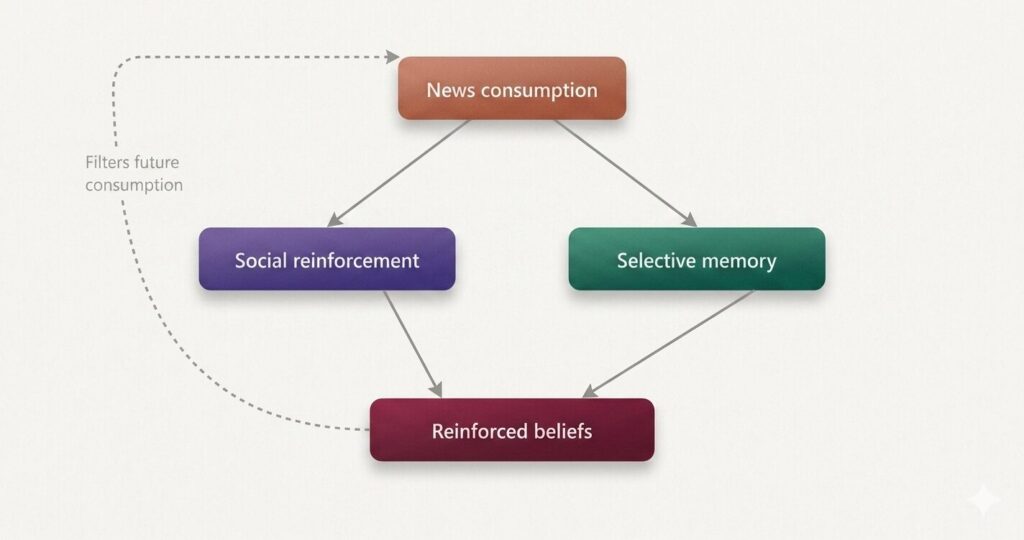
Misinformation isn’t a hammer but a series of repeated nudges toward falsehood, each building on a truth the listener already believes. With enough time and repeated exposure, beliefs shift from ‘mostly correct’ to ‘almost entirely false’ a little bit at a time. This is further cemented through memory pruning, where a person’s memories are naturally shaped by selective pruning based on density of connections. In this way, the outward misinformation narrative creates a reinforcing spiral with the person’s lived experiences. Then as the electorate becomes increasingly detached from reality, their representatives follow—either cynically exploiting or genuinely believing these distorted views This has led to a party highly susceptible to fringe beliefs and conspiracy theories, explaining their unlikely coalition – billionaires alongside anti-vaxxers, evangelical Christians alongside white supremacists – groups united not by shared values, but by a media ecosystem that presents a distorted view of the world. A view primarily motivated by their own profit.
The above narrative makes certain concrete claims. Republicans heavily rely on misinformation. This reliance leads to their constituents experiencing a consistent false narrative that diverges from objective reality and becomes resistant to correction. This creates an ecosystem that can be exploited for profit by the media and others. This leads to billionaires supporting the Republican narrative both financially and propagandistically. This further entrenches the narrative as constituents internalize and perpetuate it, causing the entire conservative media landscape to reinforce these beliefs. And this keeps progressing in a self-sustaining feedback loop.
Developing this narrative has been an iterative process over a year and a half, examining data from multiple angles. I focused specifically on significant differences between the parties and absolute magnitudes that would have a measurable impact. This led me to deep dive into topics such as rates of misinformation, candidate funding, the media landscape, and constituent accuracy. The process involves formulating hypotheses based on initial data, then actively seeking counter-evidence that could disprove them. If the counter-evidence is compelling, the hypothesis is updated or discarded, and the process begins again. The above narrative is what emerged from this process as best fitting the data. The rest of this post examines all the evidence in detail.
The metrics of misinformation
The Republican party’s reliance on underhanded tactics is evident across multiple metrics, both in absolute terms and compared to Democrats. Their messaging often indicates this is a deliberate strategy rather than a byproduct. Here are some examples:
- Take truthfulness: According to Adair, founder of PolitiFact, “Between 2016 to 2021, Republicans lied 55% of the time, compared to Democrats’ 31%” – a trend that holds even when excluding Donald Trump or examining different time periods.
- Take project REDMAP: a 2010 Republican effort to manipulate electoral district boundaries (gerrymander) in order to disproportionately win House seats. The project lauded its success at undermining the voters preference in their newsletter: “REDMAP’s effect on the 2012 election is plain when analyzing the results: Pennsylvanians cast 83,000 more votes for Democratic… but elected a 13-5 Republican majority to represent them in Washington… Nationwide, Republicans won 54 percent of the U.S. House seats… carrying only 47.8 percent of the national presidential vote.” The first election post REDMAP (Obama’s second term) gave Republicans a 33-seat advantage in the House despite Democratic candidates receiving 1.4 million more votes than Republican candidates.1
- Take obstructive tactics: filibuster use and debt ceiling fights are utilized approximately twice as frequently by Republicans.
- Take supreme court appointments: Republicans obstructed the Supreme Court justice appointment of Merrick Garland for 293 days while appointing Amy Coney Barrett in just 30 days. Republicans blocked Garland stating it would be improper to appoint a justice in an election year, then confirmed Barrett using the opposite justification—that it was their duty to confirm appointments quickly to avoid leaving Supreme Court seats vacant.
This is a representative sampling, not an exhaustive list. Across all metric, Republicans continually escalate negative tactics, Democrats sometimes follow the escalation but remain consistently below the Republican baseline. I have not found any counter examples.
Republican reliance on billionaires
For the last century, American campaign finance has oscillated between personal freedom to donate unlimited amounts and the democratic ideal of equal representation. Currently, following the controversial 2010 Citizens United supreme court decision, personal freedom has prevailed—allowing unlimited political donations through Super PACs. There are technically some limitations on how SuperPAC funding can be used, but with no enforcement it is effectively and in practice unlimited. Traditional PACs still remain bound by FEC campaign contribution limits.
According to Open Secrets, the 2024 election marked a shift: for the first time, the majority of campaign funding came from outside money. Outside money does not have to follow campaign contribution limits. This trend was driven primarily by Trump, who received 68% of his funds from outside sources (mostly Super PACs) compared to Harris’ 42%.
These topline numbers, however, don’t fully capture Republicans’ dependence on a handful of wealthy donors. American’s for Tax Fairness utilized the FEC data up through October 28, 2024 to analyze the influx of money to the 2024 election. They tracked donations from the wealthiest 150 billionaires and their families, finding:
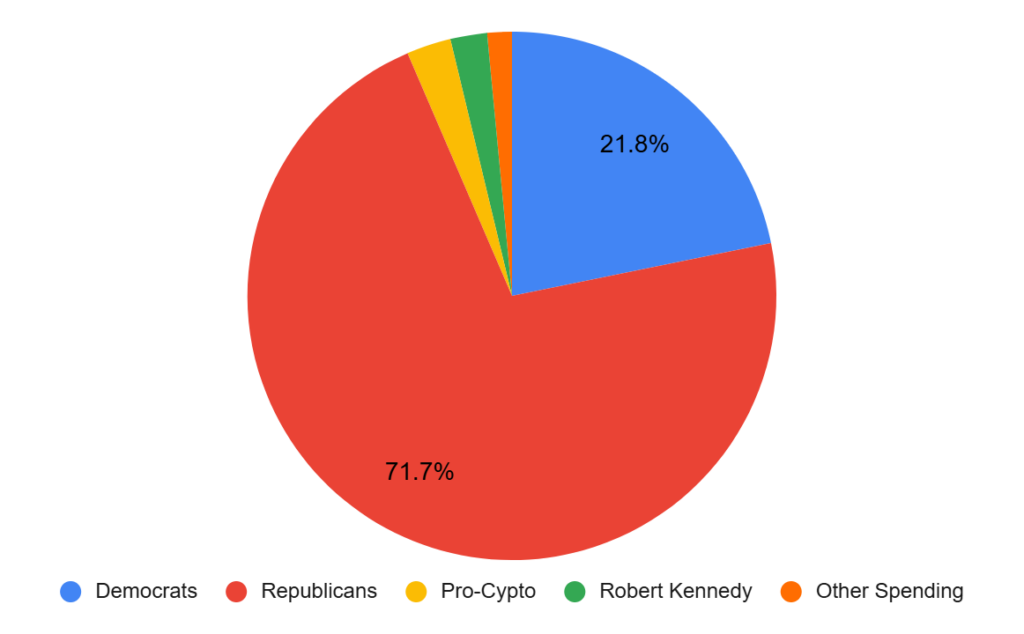
- Total contributions: $1.9 billion
- Percentage to conservative candidates: 72%
- Top five families alone: Over $600 million (all to conservative candidates)
- Percentage of Trump’s total funding from these 150 families: 42% ($492 million)
- Percentage of Harris’s total funding from these 150 families: 10% ($143 million)
While the amount of influence these billionaires have is concerning in and of itself, more concerning is how negligible these amounts are to the donors themselves. Elon Musk’s $291 million in Republican contributions for 2023-2024 represented just 0.07% of his $400 billion net worth. For perspective, a median American (net worth of $176,500) would need to donate only $128 to match this proportion—less than a week’s groceries. Taking a step back and considering the entire $1.4 billion of Trump presidential campaign, Elon Musk could have funded it in its entirety for what would feel to a middle-class American like spending $616. These aren’t charitable donations either; they’re strategic investments. The politicians, when elected, pass legislation in favor of these billionaires leading to a substantial gain in net worth. Musk’s investment of hundreds of millions has been estimated to earn him billions.
This financial reality creates a perverse incentive structure: Republicans have little reason to cater to anyone but a handful of billionaires, and they’re increasingly recognizing this fact. This financial dependency is compounded by an equally constraining reliance on media narratives. As Republican policies diverge further from popular opinion, the party finds itself beholden not just to billionaire donors for funding, but to billionaire media moguls for the favorable coverage necessary to maintain electoral viability—Rupert Murdoch’s conservative media monopoly Fox News and, increasingly, social media platform owners who control information algorithms.
The media we consume
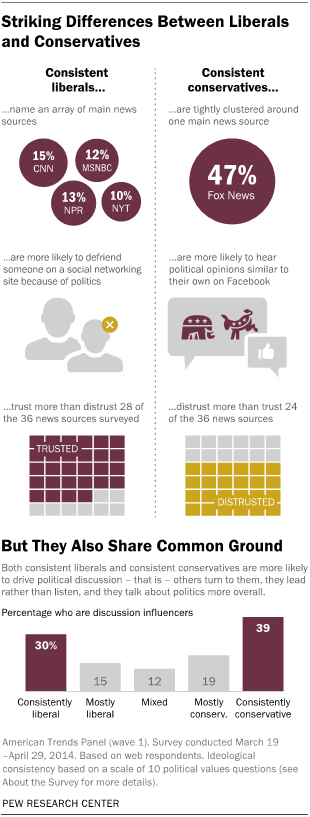
Conservative and liberals have dramatically different news acquisition habits. From Pews Research Center’s 2014 deep dive, Liberals consume varied media sources. They also trust a wide variety of sources. The most highly trusted of these (NPR,PBS,BBC) are all public news organizations owned by a wide variety of people. There is no single narrative control for the Liberal mindset.
Conservatives, on the other hand, get their news from Fox News. They trust it (88%), they listen to it for news (47% main source, 84% last week) and they distrust the majority of other news outlets. Conservatives also experience a stronger echo chamber effect, having more homogeneous friends and Facebook feeds. Even the rare conservative that doesn’t consume Fox News likely hears their news from friends and family that do. Fox News has substantial narrative influence of the conservative demographic.
The Fox News monopoly didn’t happen by accident—it was the deliberate creation of media empire builder Rupert Murdoch. As a New York Times Exposé documents, Murdoch has systematically “destabilized democracy in North America, Europe and Australia.” He drove conservative shifts in Australia through “his control of nearly two-thirds of the national newspaper market”, helped usher in Brexit in Britain via his tabloid The Sun (the UK’s highest circulation newspaper), and used Fox News to “elevate marginal demagogues, mainstream ethnonationalism and politicize the very notion of truth” in America.
Fox News operates as a politically conservative partisan channel that has spent over 20 years2 shaping conservative perceptions on political issues. Rather than simply reflecting Republican positions, Fox News has substantially influenced them, nudging the party toward positions that serve Murdoch’s interests. This creates a counterintuitive dynamic where the media outlet drives policy rather than reporting on it. As Republican speechwriter David Frum observed in 2010: “Republicans originally thought that Fox worked for us, and now we are discovering we work for Fox.”
MSNBC attempted to emulate the success of Fox News by embracing a similar model for the left, focusing on commentary over facts and pushing a progressive slant. However conservative media executed this strategy substantially more effectively. So while it’s ideologically a good counterpoint to Fox, MSNBC lacks the longevity, the trust and the reach that has enabled Fox News to narrate the conservative reality. There is no Fox News equivalent on the left.
So how effective has the Fox News strategy been? While they have monopolistic share of viewership and trust, there are other outlets for conservative media. Conversely, while having no monopolistic news network on the left allows for more variety in viewpoints, it doesn’t guarantee them. To examine this, I looked at two different approaches to tackling the effectiveness of Fox News propaganda: first, whether this propaganda gives conservatives an inaccurate view of the world, and second, how does the media in general treat politicians.
Conservatives’ distorted reality
Conservatives consistently perform worse at distinguishing truth from fiction. This is shown by a wide variety of studies and observational polling. These studies have participants rate the veracity of objectively true or false information on a wide variety of topics. Some are political based, others are more general science or knowledge based. Conservatives consistently perform worse than liberals on these studies3456 (example graphic below). This continues to be true even when normalizing for a multitude of factors: age, race, wealth, education level, etc. Unintuitively, normalizing often causes the effect to be even more extreme, while the ‘education’ factor favors liberals, the ‘age’ factor favors conservatize and age tends to be a stronger factor in isolation.
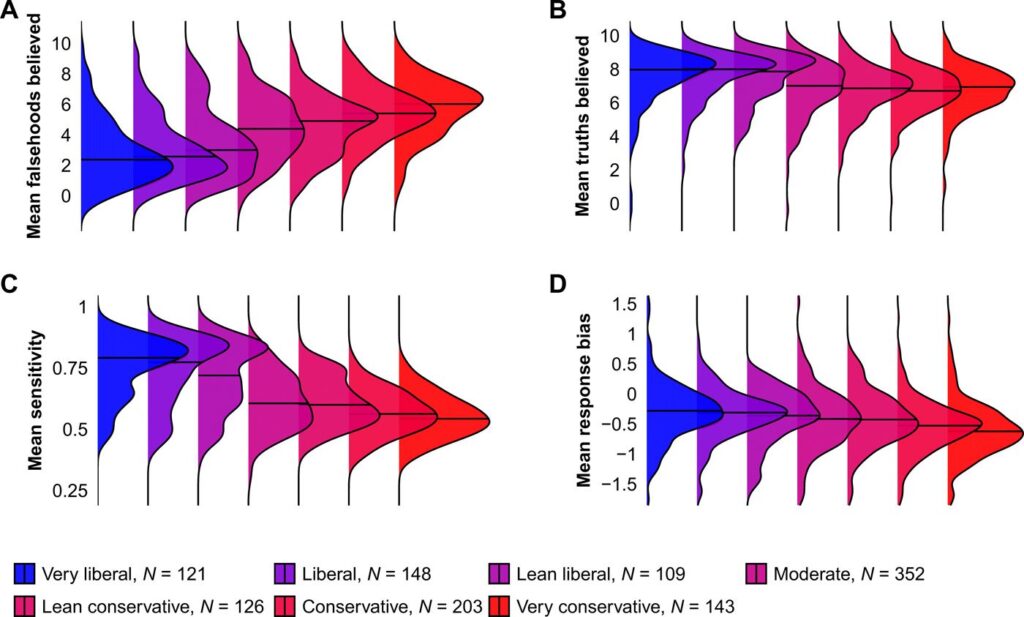
(A) The number of falsehoods believed, (B) the number of truths believed, (C) sensitivity, and (D) response bias7.
This begs a causality question, does one’s susceptibility to false information lead one to becoming a conservative or does being exposed to conservative views lead to an inaccurate view of the world. Studies try to look at this as well. Rather than looking at the veracity of the rated information, they look at the bias of the information. Here the data is more confusing. Whereas conservatives are always worse at veracity, there are studies that show all directions of bias. In these cases, the variability stems from what questions are asked and how bias itself is rating by the studies. Unlike veracity, bias study creators must first define ‘bias’ itself and then measure it. This has a tendency to set ‘unbiased’ to the ‘middle of the political spectrum’ and then just that as a measure to judge ‘bias’. But if the midpoint is set based on the variable to be measured then it’s not really measuring anything. It’s just a tautology with a bit of sampling randomness. This effect makes ‘bias’ very difficult to objectively study.
The studies that get around this the best are the larger ones that tend to rate both veracity and bias and attempt to find equivalent-ish sources on both sides. Those studies tend to show only a minor (if any) trend towards conservative’s being more biased and a very strong propensity for both sides believing statements that align with their worldview regardless of veracity. A Science Advances study summarizes this effect “Conservatives’ consistently poor performance in distinguishing truths from falsehoods appears to be largely explained by the fact that widely shared falsehoods were systematically more supportive of conservatives’ political positions.” The data suggests that the failure to critically assess veracity stems predominantly from exposure to Republican propaganda rather than any intrinsic conservative characteristic. Conservatives aren’t ‘dumb’ or ‘lack critical thinking skills’, they are intelligent humans whose exposure to repeated misinformation leads to their inaccurate world view.
How does it work so well
Human’s learn through repetition of information and making repeated synaptic connections. Events and information that occur frequently and are well connected inside the brain are amplified, ones that happen rarely are pruned. These are created throughout the day and pruned/linked during sleep. News media propaganda forms the backbone of a well connected synaptic network. Then, hearing things from multiple sources: friends, news, social media, etc. adds more connections further strengthening the network. But it’s more sticky than just external information. Slowly and surely, throughout the repeated pruning and connection process, selective memories are created. At the end, the person’s lived experience ends up backing up the same false world view. As an example, a conservative and a liberal are sideswiped by a black man with a MAGA bumper sticker. The conservatives brain during sleep connects the negativity with black and the sticker fades from their memory. The liberal connects the menace of MAGA and the color of the skin fades. The same random event, not part of a universal pattern, creates evidence for two very different beliefs. In this way, the propaganda shapes the person’s lived experience by shaping their memory creation and recollection. This combination creates a resilient belief system that proves highly resistant to abstract science or contradictory facts.
So propaganda works and it works very well, but can this be tied directly to Fox News? The Fox News Effect: Media Bias and Voting study examines this question. They look at towns that added Fox News to their cable broadcast between the years of 1996 and 2000 and then examine their voting habits during the 2000 election compared to towns that did not. They found “Republicans gain 0.4 to 0.7 percentage points in the towns which broadcast Fox News … [and] a significant effect of Fox News on Senate vote share and on voter turnout. Our estimates imply that Fox News convinced 3 to 8 percent of its viewers to vote Republican.” Fox News effectively influences its viewers even with limited exposure time.
The hours of watching Fox news narrates the reality the person is living, backed up by their friends, family and their own experiences. This then leads to a distrust of corrective forces, like experts, science and mainstream media which contradict known ‘truths’. This distrust bleeds into non political areas. The decreased trust in science and experts leads to inaccuracies across a wide variety of metrics. This in turn makes for very sticky inaccurate world views and draws in disparate people who already had those views.
So far, I’ve established several key patterns: conservative politicians rely heavily on misinformation and billionaire funding; Fox News holds a monopoly position in conservative media that allows it to shape Republican worldviews; this shaping process is demonstrably effective; and conservatives hold beliefs that diverge significantly from objective reality. But Fox News doesn’t operate in isolation – it’s part of a broader media ecosystem and this ecosystem. Within this ecosystem, even well-meaning individuals caught up in the propaganda will unintentionally perpetuate it. The misinformation shapes the ecosystem, which in turn reinforces and spreads the misinformation further. In the next section, I examine how conservative and liberal media markets differ in their treatment of politicians and objective reporting across the board beyond just Fox News.
The media’s perception
Fox News has a long history of pushing conservative viewpoints towards their own self interest. This success has captured the majority of conservative viewership and made conservatives distrusting of independent sources of narratives. But Fox News is not the only sources of conservative media, and while Liberal media is more diverse, that alone doesn’t guarantee that those sources also aren’t similarly propagating liberal propaganda.
To dig into news media perception I turn to Ad Fontes Media’s Interactive Media Bias Chart. This site rates the bias (language, topics, etc.) vs the reliability of the data/analysis of all media outlets. It does this by rating individual articles and than aggregating them for the site. Scanning it, you can see a vaguely pyramidal shape shifted left of center. This coincides with a fairly consistent 6 point reliability bump for the Left at all bias levels. This is expected given the previous information. Given the polling gap between conservative policies and public opinion, the conservative media, similar to the politicians, need to rely more heavily on selective framing and misinformation to be equivalently convincing.
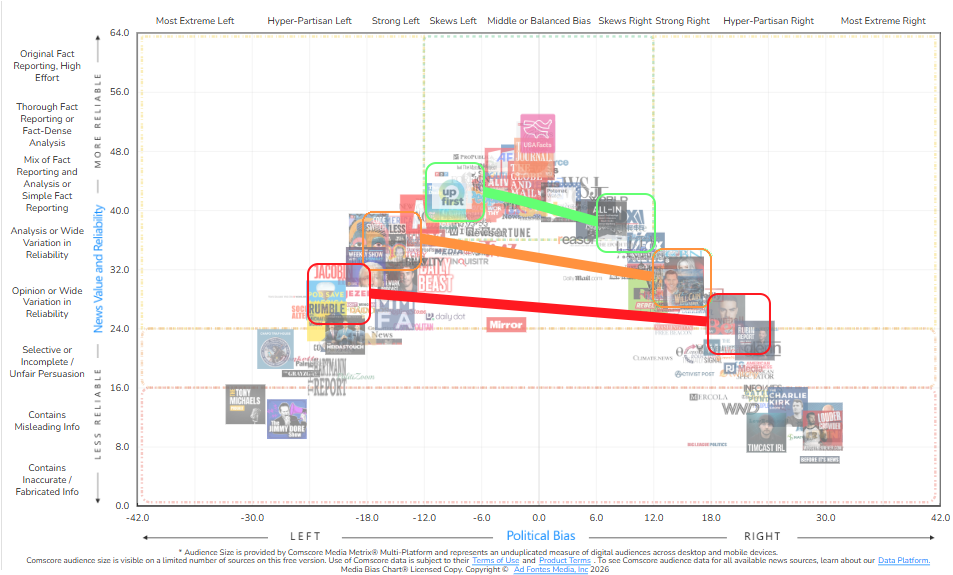
The reliability shift across the spectrum isn’t the only difference the data shows. Both sides aggressively attack their opponents, but that’s where the similarities end. Left media portrays the world as a catastrophe and all politicians as culpable. It advocates voting for the ‘lesser of the two evils’, but the articles and constant vitriol make it easy to get overwhelmed and lose sight of which that is. Right media, on the other hand, tends to frame Republicans more favorably, presenting them as advancing beneficial policies against obstructionist opposition. It is very rare to find self critical press and the ones that exist are surrounded by ‘benefits of the doubt’ language.
This trend was fairly overt and constant via scanning at several different times (Nov ’24, Feb ’25, Oct ’25, Feb ’26), but to quantify, I used the Interactive Media Bias Chart and sampled 50 Left and 50 Right articles all pulled from their respective ‘Strong’ category in the 32-40 reliability. I pulled without looking at the articles and, as best as able, pulled mirror location articles. Then I categorized based on whether the content was primarily positive or negative and which party it was towards (or neither) and then collated. The data shows the trend: the media treats the opposing party similarly, but their own party remarkably different.
Looking at the articles themselves also shows even more nuance in the difference. The left articles often have an exhausted feeling, showing how, even in success, the Democrats continue to fail. The right articles have a betrayal feeling, showing Republicans making mistakes or going rogue. Also somewhat hidden in this difference is an oppressive negativity that pervades the Left media. Reading articles from the Left evokes the feeling that everyone in positions of authority are complicit or evil. The Right has heroes to root for, the Left just has exhaustion.
This asymmetry has an effect on individuals that is shown in studies as well. This Communication Psychology study measured ‘response bias’ – the tendency to judge content as true or false regardless of actual veracity – by having participants rate news headlines that favored specific parties. The top lines show similar to all the other studies in this space, but their analysis broke the bias down further. This drilldown revealed an asymmetric pattern that parallels the media being consumed: while Republicans exhibited positive bias toward Republican-favorable content and negative bias toward Democratic content, Democrats showed skepticism toward all content, with an even stronger skeptical bias toward pro-Democratic headlines (see c below). While the magnitude is substantially different, both Democrats’ and Republicans’ biases are in the same direction: towards Republicans.
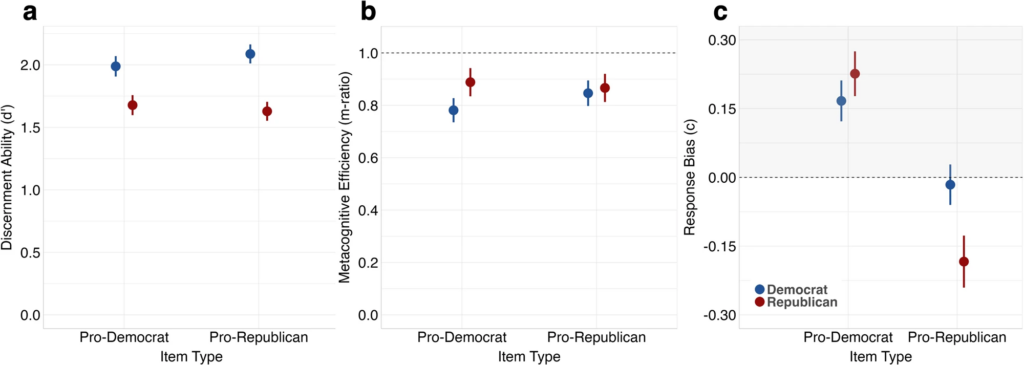
The media we consume pervades our view of the world and it shows a very different world for both the Left and Right. It can be easy to write L/R off using a false equivalence, two sides of the same coin, both pro their side and anti the other, but this isn’t backed up in the data. The media consumed is different and the viewers themselves are different.
Conclusion
The data reveals a clear pattern. Republicans heavily rely on misinformation (Metrics) while isolating their constituents from outside sources of truth (Mistrust). The consistent false narrative becomes the reality conservatives experience (How it Works), leading their beliefs to diverge from objective reality and become resistant to correction (Distorted). This creates an ecosystem ripe for exploitation (Investments), attracting billionaire support both financially (Billionaires) and through propaganda outlets (Fox). This further entrenches the narrative as constituents internalize and perpetuate it, causing the entire conservative media landscape to reinforce these beliefs (Media). The result is a self-sustaining feedback loop.
Propaganda works – not universally, but consistently enough to matter. Fox News has demonstrated that sustained, coordinated messaging can influence not just political opinions, but perceptions of reality itself. The gradual shift from “mostly correct” to “increasingly inaccurate” happens incrementally, making it difficult for even intelligent, thoughtful people to recognize the change. When combined with billionaire funding structures that weaken electoral accountability, this creates a reinforcing system where policies can maintain power despite limited popular support.
This covers a substantial portion of the story, but it remains incomplete. The strongest data comes from patterns built over decades, yet Fox News’s influence resonates most powerfully with older demographics. It has been a monolith for the last 20 years, driving conservative media and shaping modern politics. Yet the world is evolving and the next generation’s media consumption looks fundamentally different. As consumption shifts from television to digital platforms, the techniques for shaping narratives have evolved beyond traditional media empires. The next section examines how social media has amplified and transformed these dynamics, creating new patterns in our information ecosystem and extending influence capabilities to a broader range of actors.
- Democrats have since countered through both their own redistricting efforts and legal challenges. While the current gerrymandering advantage has narrowed to approximately +2 Republican seats, the lasting damage continues. Obama’s second-term agenda was severely limited by an artificially Republican House, and more critically, the gerrymandering process itself continues to intensify partisanship by creating safe districts that favor extreme candidates. ↩︎
- Fox news was founded in 1996, but it wasn’t until it’s coverage of the Iraq war in 2003, 22 years ago, that it’s viewership became large enough to strongly influence the conservative narrative(wikipedia) ↩︎
- M. Sultan, A.N. Tump, N. Ehmann, P. Lorenz-Spreen, R. Hertwig, A. Gollwitzer, & R.H.J.M. Kurvers, Susceptibility to online misinformation: A systematic meta-analysis of demographic and psychological factors, Proc. Natl. Acad. Sci. U.S.A. 121 (47) e2409329121, https://doi.org/10.1073/pnas.2409329121 (2024). ↩︎
- R. Kelly Garrett, Robert M. Bond ,Conservatives’ susceptibility to political misperceptions. Sci. Adv.7,eabf1234(2021).DOI:10.1126/sciadv.abf1234 ↩︎
- Dobbs, M., DeGutis, J., Morales, J. et al. Democrats are better than Republicans at discerning true and false news but do not have better metacognitive awareness. Commun Psychol 1, 46 (2023). https://doi.org/10.1038/s44271-023-00040-x ↩︎
- Rathje, S., Roozenbeek, J., Van Bavel, J.J. et al. Accuracy and social motivations shape judgements of (mis)information. Nat Hum Behav 7, 892–903 (2023). https://doi.org/10.1038/s41562-023-01540-w
↩︎ - R. Kelly Garrett, Robert M. Bond ,Conservatives’ susceptibility to political misperceptions. Sci. Adv.7,eabf1234(2021).DOI:10.1126/sciadv.abf1234 ↩︎